
Your Online Visibility Machine
You can’t get found online these days just by relying on one channel like your website. Online visibility is built using five channels: your website, Google Ads, social media, video, and Google Business Profile, each contributing their unique superpower but working together as a team.
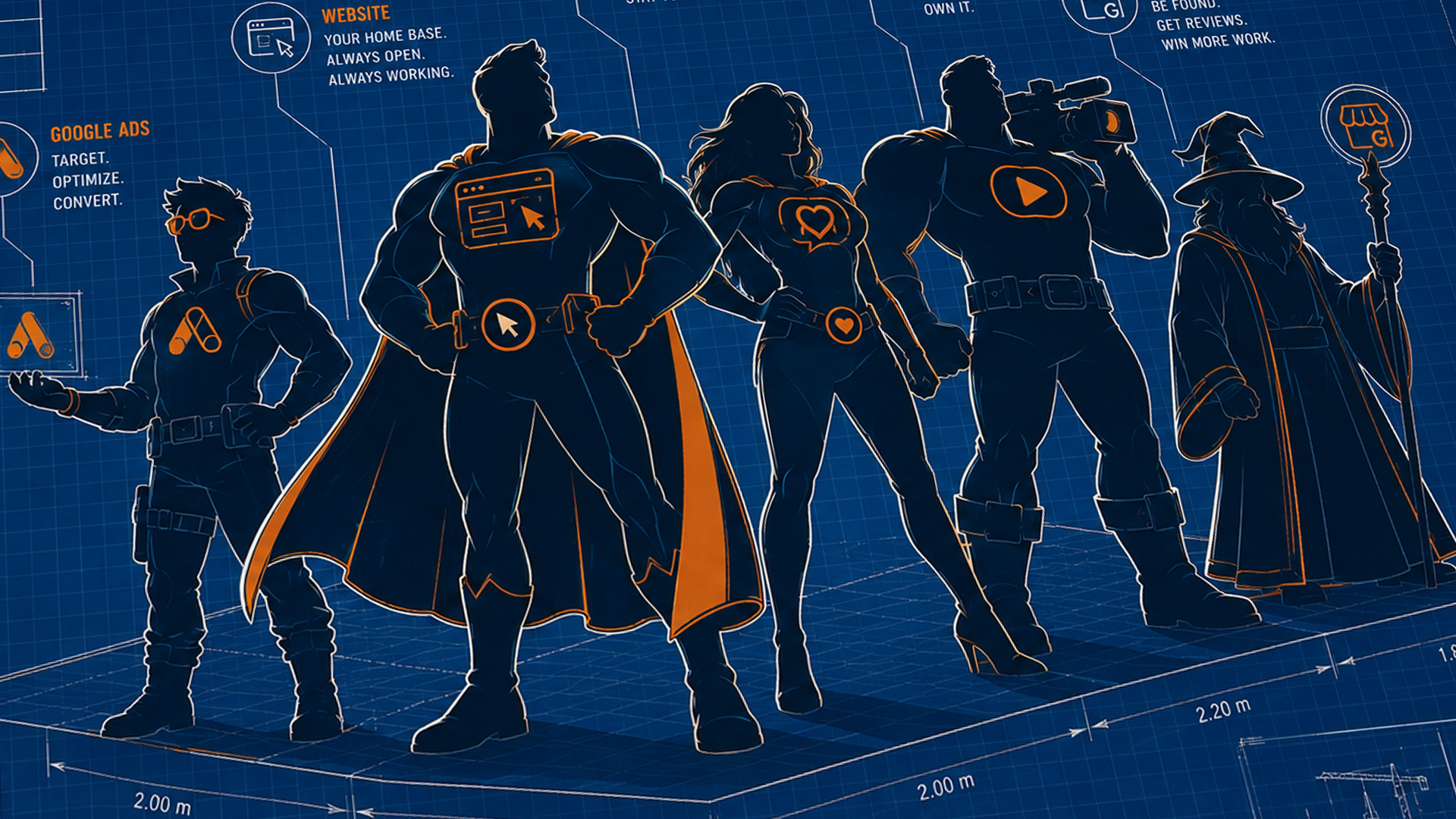
Your online visibility machine is a system of the five main channels you should be constantly managing, your website, Google Ads platform, social media, video library, and your Google Business Profile. Working closely together they get your company found, trusted, and chosen by people searching for what you offer, as well as the search and AI bots trying to match those people with the right building partner.
Think Avengers over Superman
Instead of the traditional Superman model where your website does all the superhero duties alone, today's online visibility system is more like an Avengers team, capitalizing on the unique strengths of each member so the sum is greater than the individual parts.
A superhero team does its best work when each member contributes their talents evenly. Everyone has a role to play. Let one hero slack off, sit out a mission, or stop training, and the whole team goes off kilter, the villain finds the gap and exploits it. Builders have to work all five parts of this system together, constantly training and improving, or the team never performs at full strength.
Running the machine means you're constantly monitoring, optimizing, paying attention to how one hero's performance affects the whole team's output. Do that consistently, and the team gets stronger together: you earn priority positioning in the search results, get cited by AI Overviews when prospects ask their questions, and stand above a sea of competitors throwing out empty, desperate tactics.
Let's take a look at each member of the team and how they contribute to the health of the whole squad.
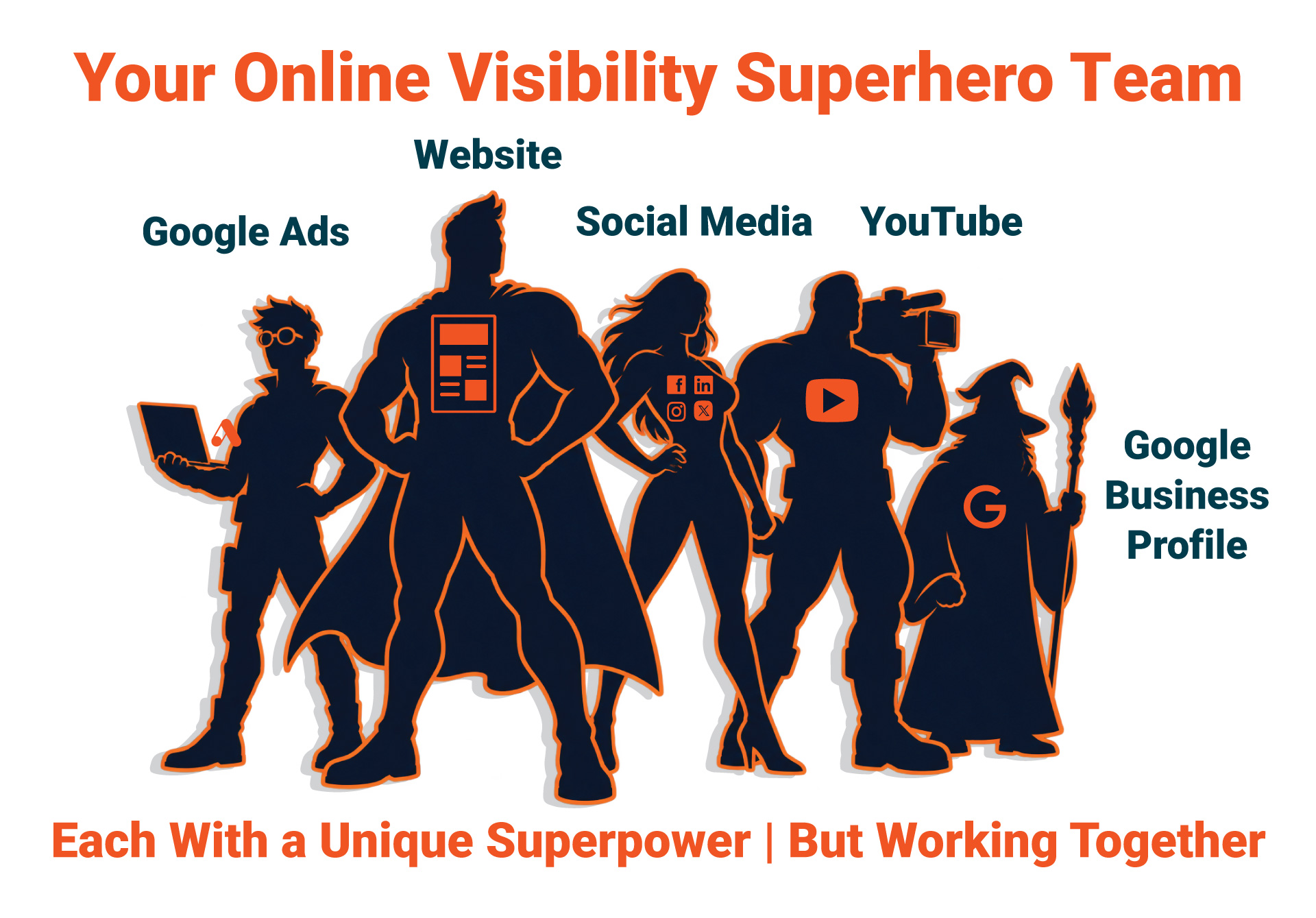
Superhero 1: Your Website - The Frontman
Your website is the main character of the group, charismatic and not afraid of the spotlight. It is still the foundation of your online reputation, and it has two important superpowers.
Its main job is to be your company's charming ambassador once your prospects arrive for a tour. Remember, visitors are skeptical and short on time. Like a billboard along the highway, it has to hook your audience immediately and lead them on a compelling journey toward a clear call to action.
Its second role is to be a deep well of unique, expert information for the rest of the machine to draw from. Social media posts link back to it. Your Google Business Profile references it. AI Overviews cite it. It needs to be stocked with fresh water to quench a thirsty audience.
Minimize the self-serving fluff and fill your website with helpful, specific content like articles, project breakdowns, and thoughtful service pages. Provide expert answers to the exact questions your key prospects are typing into search and AI engines. The goal is to present yourself as a trusted authority in the subject matter rather than a replaceable vendor.
Superhero 2: Google Ads - The Gadget Geek
Google Ads, on the other hand, is the nerdy data-loving character whose job it is to exploit the technology to invite potential prospects into your “universe”.
With how saturated the Google Ads space has gotten, it's easy to give up on a campaign out of frustration, convinced it's a waste of money. But usually it's because builders invest too little, expect too much too fast, abandon it before it has time to learn, and run it with nothing else supporting it.
Keep in mind some corners of the building industry are brutally competitive. If you're not at the top of the page, it's not necessarily your campaign failing, it may just mean dozens, sometimes hundreds, of similar companies are bidding on those same keywords.
Your ad campaign bids on the keywords you predict prospects will search for. Do the research, set a realistic budget, and use those same keywords across your organic components too: your GBP, website, and social media. Then track what's working, prune what isn't, and double down on what is.
Monitoring and optimizing your Google Ad campaign takes time and patience. If you stick to it you allow the search and AI engines to learn about who you are and what you offer, and used in tandem with your organic channels it will slowly compound your visibility.
Again, don't expect Google Ads to rescue you immediately without any help. Instead, it’s weak without support and only succeeds as a supporting role among the bigger team.
Superhero 3: Social Media - The Hot Character
Social media is the buxom character that throws in the sex appeal. It has three superpowers, and most builders only use one of them. The first is obvious: sharing content (projects in process, products put to the test) to gain visibility on LinkedIn, Facebook, Instagram, or wherever your audience actually spends time.
But if that's all you do, or more realistically, your twenty-something receptionist does, you're missing out on the real power of social media. The second is planting a seed in future customers' minds that you're a trusted expert worth partnering with one day. Every comment you make on other people's posts, every conversation you participate in, builds that reputation. The algorithms on Meta and LinkedIn start recognizing you as someone worth paying attention to, and they begin prioritizing your posts, building you into their own internal sense of who the authorities are in your space.
The third, and maybe the most underrated, is social media's unmatched ability to target the exact client profile you're after. Set up a paid campaign on Facebook, Instagram, or LinkedIn, feed it accurate criteria for who you want in front of, and there's no better investment in the advertising space for precision like that.
This character is all about attraction at its core. Once you're recognized as an authority on these platforms, search engines and AI bots start factoring your social presence into their answers too. When someone searches for a company like yours, your social activity becomes one more signal telling the algorithm you're legitimate, active, and worth recommending.
Superhero 4: Video - The CGI Muscle
Video is the oversized CGI superhero who usually gets overlooked, but when called on by the team, uses brute strength to save the day.
A library of videos teaching your craft, explaining your process, and showing your team in action is one of the most underused tools sitting right in front of you. It wins over your future customers with a face-to-face conversation. It showcases your niche expertise and positions you as the expert in your field. Above all else, it's the magic elixir that builds authority with search engines and AI platforms.
In the age of smartphones, you have no excuse not to get your insights on video. Don't get self-conscious if it's not a Hollywood production. Keep it simple and direct, no fluff.
To post your videos, access your Google Business Profile, then navigate to your company's YouTube account in the list of applications in the upper right corner. Click "Create" and follow the prompts. Include helpful information in the title and description, that's what the search bots are picking up on.
Build your library with intention. Instead of a junk drawer of random topics, organize videos into categories based on the questions you already know your prospects will ask. Keep it clean and simple, resist the urge to be theatrical. And don't get discouraged by a handful of views at first. The goal is to build a reputation online over time, one that compounds and becomes a powerful contributor to your visibility machine.
Superhero 5: Google Business Profile - The Wise Overseer
And we all know the superhero team would fracture and implode without the one wise character overseeing them all back at headquarters.
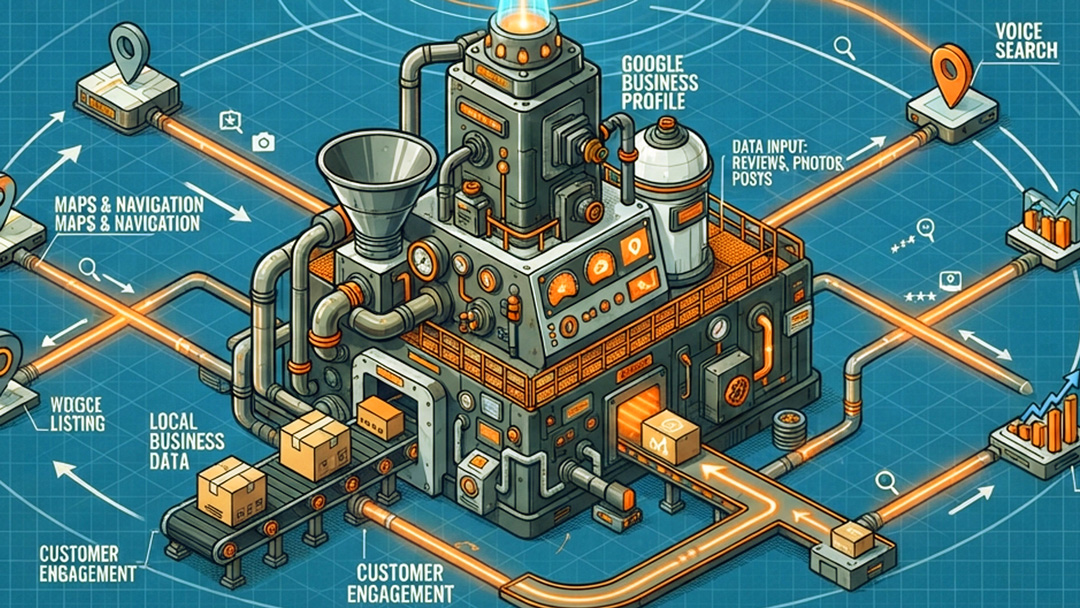
I can't stress this enough, especially because so many builders ignore it: in my view, the GBP has become the center of the entire online visibility machine. It's essential to getting found today by search engines, AI, and humans alike. Not because it replaces the other four parts, but because it captures all of them in one place.
Your GBP can hold articles, insights, and now video, pulling pieces from every other channel into a single dashboard that both prospects and algorithms check first. Say you post a new project walkthrough video, that same week it can live on your GBP right alongside the case study you wrote about the project on your website and the client review that came in once the job wrapped.
One project, three channels, all converging in the one place a prospect and an algorithm both check first. A company running strong content on their website but ignoring their GBP is leaving most of that work on the table. A company doing all five parts together, feeding the GBP from every direction, is operating at a different level entirely.
But your GBP is not just a mirror of the other four channels. It clarifies your categories, service areas, hours of operation, and other vital information that will influence search results on its own, even more than your website or social activity.
And within the GBP, nothing matters more than reviews. You can talk about how good you are all day long on your own website, your own social posts, your own video library. None of that carries the weight of someone else, a peer who went through the exact experience your next prospect is about to go through, saying it was a good one. Skeptical buyers trust other buyers. That's not new, but it's more visible and more measurable now than it's ever been, and both the search bots and the AI bots are reading it right alongside the humans.
Reviews also do double duty: beyond building trust, they're one of the strongest signals feeding your ranking in the local pack, the map and short list of businesses that shows up above the regular search results for local and regional searches, the exact spot where most buyers stop scrolling and start calling. Most of your competitors are still ignoring that piece of real estate entirely.
Get in the habit of adjusting and contributing to your GBP every time you take action on the other four components. Every new case study or article on your website, every social post, every testimonial should get added to your profile too. Regularly tweak your information, optimize your service offerings, and add new images. Search and AI bots prioritize fresh, active profiles, every time.
Bonus: AI - The Eye in the Sky
Here's where AI actually earns its place in this action flick, as the eye-in-the-sky character who watches the action from above to give the whole superhero team the advantage.
Plug AI into your channels, your website traffic, your ad performance, your social engagement, your GBP activity, and it gives you objective feedback in real time. This gives you a superpower you never had before, the ability to run your marketing without relying on gut feelings.
Say your GBP posts about your steel fabrication work are pulling three times the interest of your posts about general capabilities. Unless you're a marketing data nerd with plenty of time on your hands, that would have escaped you before. AI now hands you that hunch-free intel, so you know exactly where to lean in.
Sometimes that feedback points to something small: tweak a word or a headline on one page. Other times it points to something bigger: your social strategy needs to be rebuilt from scratch, or your GBP has gone stale and needs real attention.
That's the real value. Instead of treating your website, your ads, your social presence, your video, and your GBP as five separate projects competing for your time, you finally see them as one team, covering for each other, training together, and pointed at the same target, the eye-in-the-sky telling you exactly which hero has gone soft before the whole team gets exposed.
Your Team of Superheroes, Assembled and Working for You
95% of the time, the vendor who wins the job was already on the buyer's online shortlist before anyone ever picked up the phone. The pitch, the proposal, the handshake, all of that happens after the outcome is largely decided. The real conversation has already happened without you knowing it, online, in the search results and profiles and reviews a prospect combs through before you even know their name.
None of these five parts is optional if you actually want to compete for attention today. A great website with no social presence is invisible. A stacked GBP with no video or articles feeding it runs on fumes. Google Ads without a strong organic foundation and clear call to action behind it is just an expensive way to rent temporary visibility.
Build all five together, and you've assembled a team that works for you around the clock, earning trust with real people and feeding the right signals to every bot deciding who gets recommended next.
Most of your competitors are still treating their online presence like a business card they filled out once and forgot about. Their “Superman” is out of shape and sucking wind. With your five superheroes trained, coordinated, and standing shoulder to shoulder, when the next big opportunity comes into your universe, your team is already assembled and ready to win the work.

Written by Rusty George, with almost zero help from Artificial Intelligence. It was built the old-fashioned way. Splinters and all.
Rusty George leads a branding, website design and marketing agency serving construction companies, developers, subcontractors, manufacturers, material fabricators and suppliers. Reach out anytime to learn about how to put your 5 key online visibility superheroes to work for your building business.
MORE Insights
Unlock the secrets to transforming your construction company into a marketing powerhouse with Louder Builder.

How Much Should a Builder Spend on Advertising?
The Google Business Profile
SIGN UP FOR UPDATES
We will send you our latest insights from Louder Builder as they are released.
CONTACT US
Are you ready to begin your project today? Just have a few questions?
Either way, let’s talk.