
The Google Business Profile
Your Google Business Profile has become the central tool keeping you visible to your future customers. But most builders neglect or ignore it completely. That’s no longer an option.
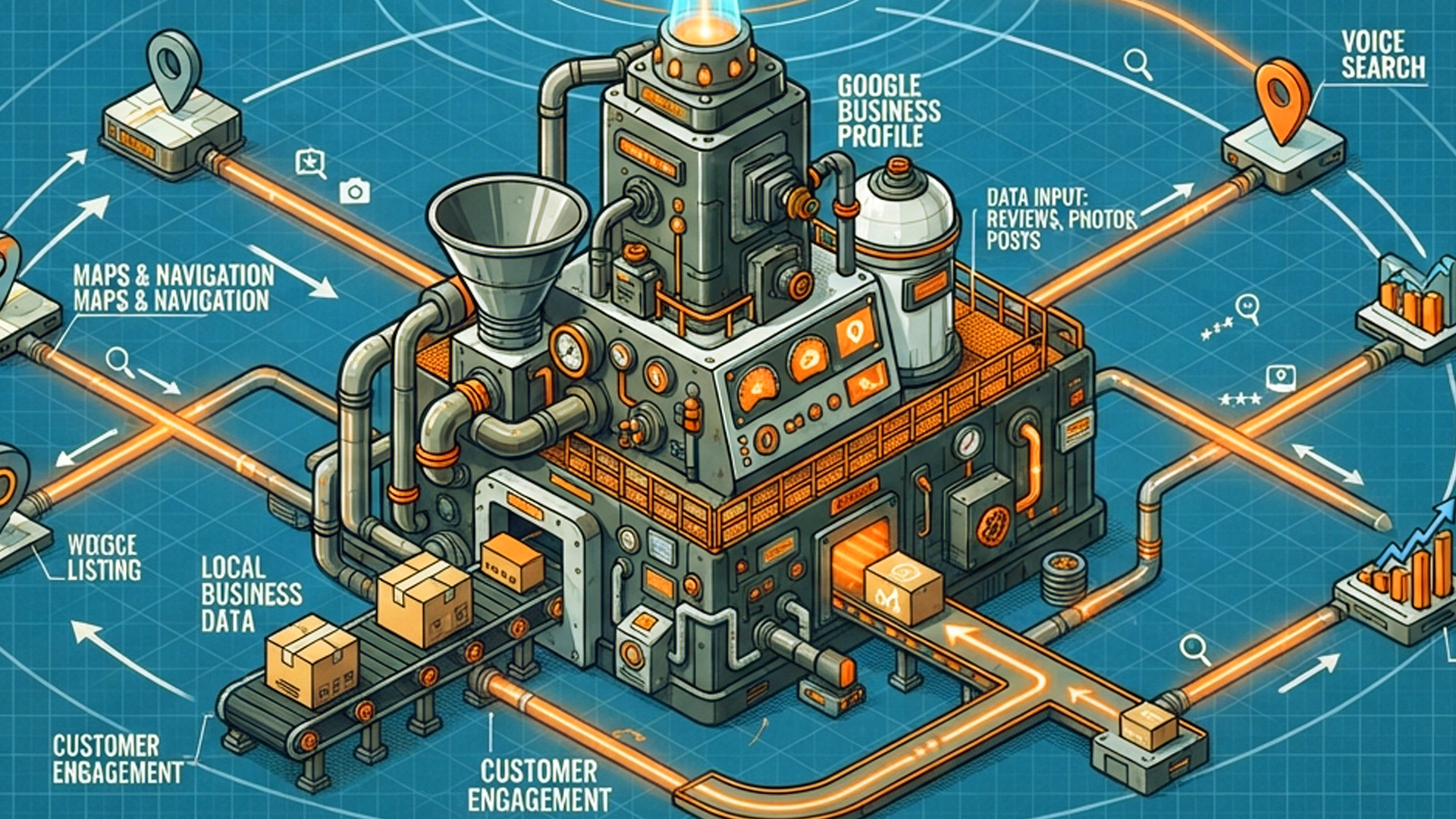
When was the last time you looked at your company’s Google Business Profile? Have you ever stopped to think how valuable it really is, even for builders?
Restaurants, retailers, and dentists have long known how vital their Google Business Profile (GBP) is to keep new customers coming in. And while roofers, plumbers, and home services companies also get it, I've found it's harder to convince other building-based businesses just how important a role your GBP plays in attracting new work, especially in this AI-driven age.
Your GBP has long been a free advertising opportunity courtesy of Google, encouraging businesses to contribute their information so potential customers can quickly tell whether they're a good fit. It's also Google's back-handed way of crowdsourcing business data from around the world without lifting a finger themselves, but that's a discussion for another day.
Google still dominates around 92% of search traffic worldwide, and even as AI tools change how people research, it's almost guaranteed your prospects are starting there, typing in "steel fabricator near me," "HVAC contractor for commercial buildout," or "industrial coatings supplier, Phoenix."
And when they do, your GBP controls up to 50% of your visibility in their results. It is the go-to resource for search engines, AI answer engines, and actual humans looking for your products and services. It’s become the new center of a builder's modern marketing ecosystem, essential to pull prospective customers into your orbit.
Today's Real Storefront
Your website has long been thought of as your company's digital storefront. It was developed, launched and all you needed to promote your business online.
That's not really the case anymore. Recent studies show up to 68% of all Google searches end at your GBP without ever reaching a website.
Your ideal future clients are researching online for the right partner for their upcoming project. They're distracted, skeptical, and short on time. If they have everything then need to make a decision at the GBP level, why would they bother clicking through to an actual website?
I'm not saying scrap your website. But instead of thinking it's your one and only online business development tool, understand its new role in partnership with the GBP, which has taken over the central position of your inbound visibility machine.
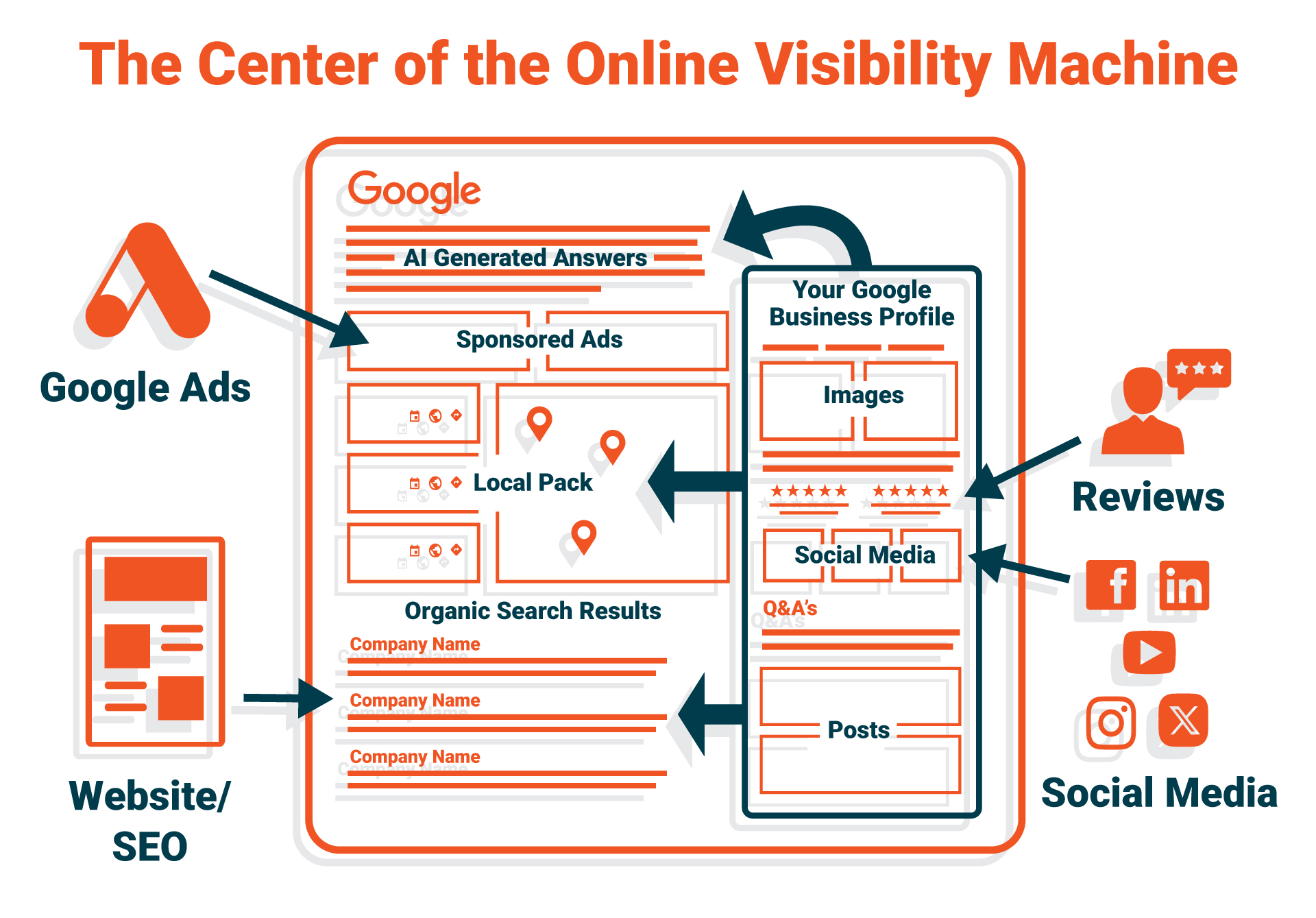
How the GBP Influences Google Search Results
At the top of a Google search results page, you'll now typically see AI-generated paragraphs (called AI Overviews) doing their best to answer the user's question, surrounded by a block of paid ads. After that comes the "local services pack," a map and list of business listings pulled directly from GBP data, and only then, pushed further down the page every year, is the traditional list of organic website results.
That local pack is prime real estate, especially for a B2B search with local or regional intent like "commercial roofing contractor Denver" or "concrete supplier for industrial projects." A contractor with a mediocre website but a genuinely well-maintained GBP can outrank a competitor with a beautiful site and a neglected profile, in the exact spot buyers look first.
Also, AI Overviews draw heavily from your GBP, in some cases up to 20-35% of all generated answers are coming from GBP’s alone. Because that data is location specific and tied directly to your business, AI treats it as a trusted starting point before it even checks your website.
What Goes Into Your GBP
Remember, everything on your GBP is earned, not paid for. This isn't a set-it-and-forget-it strategy. You need a plan to regularly update, improve, and optimize your profile for it to actually return results.
Start by nailing down your profile’s business description field. These are essential to efficiently attract the right kind of customers. Make sure it covers everything your company does blended with what your ideal future clients may be looking for. Be specific about your categories. Are you a general contractor or a roofing contractor? A metal manufacturer or steel fabricator? Try to be as detailed and thorough as possible.
Fill out the Q&A section with smart answers to the questions you already know they'll have. Remember, you're not a needy vendor here, you're a seasoned expert in your niche. The more you can show that, the better your odds of getting picked over the competition.
Get into the habit of posting to your profile on a weekly, or even monthly basis. While quality content matters to search engine bots, so does consistency.
Resist the temptation to overstuff your posts with jargon or bait words trying to trick the search engines. Think about who your ideal future customer is and what they're actually looking for. Write like you're talking to them one on one.
Walk through your services and categories in detail, describe your business process, and share experiences from your latest projects. Share certifications, awards and recognitions. Add photos not just of the finished product, but of the process too, so prospects can learn from it and get to know you a little better.
Try to add video if that’s something you do. We see very few building companies taking advantage of this feature, and nothing builds trust with your audience faster than seeing and hearing you and your crew in action.
Don’t ignore the section that offers links to your social media pages, which you should also be keeping up on a regular basis. A conduit to your expertise, capabilities and insights on these platforms boosts the confidence of the search engine and AI bots trying to get a clearer understanding of what you offer.
And definitely build a plan to collect more testimonials for the Google Reviews section. Like I said, nothing beats peers saying good things about your company. And both search engines and AI bots judge you if you only have a handful, or none at all.
Don't get disheartened if you see companies out there with hundreds, even thousands, of reviews. I've actually heard that too many reviews can turn prospects off, it starts to feel artificial and commoditized.
Instead, aim for a respectable amount based on your category. If you interface directly with the public, aim higher. A typical B2B company can do well with just a few dozen. And get in the habit of responding to new reviews, to show appreciation and responsiveness, especially if you get a less-than-desirable rating. Be courteous, but also explain your side if you receive an unfavorable review. Your prospects don't expect you to be perfect, but being engaged and empathetic is far more powerful than an unaddressed review.
Make asking for reviews part of your process. Log into your company Google Reviews page and above the testimonials section there should be a link that says “Ask For More Reviews.” Copy and send that link upon any project completion, or just as a friendly email. Most satisfied clients are happy to help you. All you have to do is ask.
Taking Command of Your GBP
Before any of this matters, someone at your company needs to actually own the Google Business Profile. It needs to be verified, with admin access under a company-controlled account, not a former employee's personal Gmail from a decade ago.
Verifying and taking ownership is the unglamorous first step, and it's non-negotiable: an unclaimed or improperly owned profile can't be optimized, and worse, can be edited by anyone.
Type your company's name into the Google search bar. Hopefully you're listed there.
If you've never touched it, your GBP starts out by showing a rough summary of what Google has found about your company. It pulls an image of your building's front from Google Maps, along with data from wherever it can find it, mainly your website, but also Thumbtack, Angi, or associations you might belong to.
If your company already has a listing:
The first step is to claim it. Within the information square under your name and contact info, look for the snippet that says "Own this business?" and follow the instructions. You may need to set up a Google email address if you don't already have one, and you may be required to receive a postcard in the mail at your business location to prove you are who you say you are.
If your company doesn't have a listing yet:
Type your exact business name and city into Google Search or Google Maps to confirm nothing comes up. If it's truly missing, open Google Maps and select the option to add your business.
- Provide your business name, accurate category, address or service area, and phone number.
- Complete the verification method Google offers (phone, text, email, or video).
- Wait for review. Again, this may require a postcard mailed to your location with instructions to confirm ownership.
- Google typically takes up to five business days to approve verification requests.
If someone else already owns your listing:
This is where it gets tricky. Go to Google Maps and click "Claim this business" on the profile square, then look for a link that says "Request access." Click it and follow the instructions.
The current owner has three days to respond. If they ignore or reject your request, appeal directly through Google Support with official proof of business ownership.
From helping clients navigate this frustrating process more than once, our main advice is: be patient and tenacious. Google works at its own pace and isn't very responsive on these issues, and your request is one of thousands it receives every day. Add AI into the mix now handling a lot of this on their end, and you have to just keep at it until you finally break through.
Once you've claimed it, you can start building an arsenal of information and insights that speaks directly to the audience you're trying to reach, buyers, algorithms, and AI systems alike. All it costs you is time and thoughtful, regular input.
Paid Vs. Organic Visibility
You may be thinking, "Great, if I invest time and resources into building my GBP, I don't have to waste money on PPC or other digital advertising." Not quite.
Having a robust GBP gives you a real competitive advantage over companies who ignore theirs, but it's better to think of Google Ads as the other half of the system, not as something you get to replace because of it.
Your GBP and website work together for online visibility, but is a long game play. It builds slowly, but once it's built, it keeps working without a recurring bill, and it earns a kind of trust that paid placement can't buy.
Google Ads is the opposite. It actively seeks out and drags in specific audiences you paid to get in front of. It costs you money but every dime you spend produces an instant result.
The two aren't in competition, they solve different problems. Ads make sense when you need volume fast, you're entering a new market or service line with no track record yet, or you're bidding on a specific high-value term where a competitor already owns the organic and local pack real estate. Organic and GBP make sense as your foundation, because it compounds and it's what most of your competitors are neglecting.
Don't choose one over the other. Build your GBP because it's free and it compounds. Use Ads strategically, for speed, for testing, or for the specific terms worth fighting for.
The AI Angle
The best way I've found to bring AI into this process is its ability to instantly turn market research into a sharper GBP. Used right, it takes the guesswork out of your inbound strategy and gives you an edge most builders don't have yet.
There are AI agents now, software running on top of the major AI platforms, that can monitor your ad campaigns, your website, and your GBP simultaneously, tracking visitor traffic and behavior in real time. They synthesize all of it into plain feedback: what's working, what isn't, and a clear next move.
That feedback should shape how you write your GBP services, categories, and posts, how you run your Google Ads campaigns, and where you adjust your website. Instead of updating your GBP on a hunch or a whim, you're updating it based on what your actual prospects are doing.
Why This Matters Even If You're Already Booked Out
You might have plenty of work at the moment and aren’t actively looking for new customers, so there isn't an immediate urgency to fiddle with your GBP. But getting into a habit of monitoring and maintaining your GBP is an investment in long-term growth and scalability.
Markets shift. Buyers evolve. But the internet is forever. You shouldn’t think of your GBP as a lead-gen tool for the desperate, but a way to deliberately stay visible both now and in the future.
For manufacturers, contractors, fabricators, suppliers, and engineering firms, the Google Business Profile remains one of the last truly free, high-leverage pieces of digital real estate.
It doesn't matter what category you're in or how lead-dependent you are, taking command of your GBP and incorporating it into your business development routine hands you advantages your competitors are still ignoring. They're ripe for the taking, right now.

Written by Rusty George, with almost zero help from Artificial Intelligence. It was built the old-fashioned way. Splinters and all.
Rusty George leads a branding, website design and marketing agency serving construction companies, developers, subcontractors, manufacturers, material fabricators and suppliers. Reach out anytime to get more information about how powerful your Google Business Profile is for you visibility online and to bring new customers in.
MORE Insights
Unlock the secrets to transforming your construction company into a marketing powerhouse with Louder Builder.

Your Online Visibility Machine
Content Marketing: The Best Biz-Dev Tool You're Already Qualified For
SIGN UP FOR UPDATES
We will send you our latest insights from Louder Builder as they are released.
CONTACT US
Are you ready to begin your project today? Just have a few questions?
Either way, let’s talk.