
How Backlinks Benefit Builders
Inbound linking may be the secret behind why some websites show up on page one of Google and yours doesn't.

I was talking the other day to a remodeling contractor who was frustrated because she had made a sizable investment of time and resources to update her website, but it was still languishing on page 3 on Google, which means it was pretty much invisible.
Her marketing team had loaded it up with attractive keywords, cleaned up the content and made the site sharper and more appealing to her prospects. Still she couldn’t figure out what was missing.
So I ran a quick diagnostic and found the culprit pretty fast. Her site had low domain authority. It wouldn’t matter how attractive her keywords were or optimized her content was, low domain authority was keeping her buried in purgatory.
Your domain authority is like your website's credibility score. It's how much weight Google and other search engines give your site compared to others in your space. A lot of factors go into that score, but one of the biggest ones is the amount of inbound links your website has.
What Are Backlinks and Why Should You Care?
An inbound link, also called a backlink, is simply when another website links to yours. When a trade association publishes a member directory and includes your website address, that is an inbound link. When a supplier you work with lists you as a certified installer on their website, or a local business journal writes about a project you completed and links to your company’s site, that is an inbound link.
Google and other search engines treat these links as endorsements. The more credible websites that link to yours, the more Google trusts that your website is worth showing to people who are searching for what you do. It is one of the most significant factors in determining where you rank in search results, and it has been that way for over two decades.
Google and other search engines, as well as AI LLMs treat these links as endorsements. They are impressed when they see many credible websites linking to yours, and they begin to trust you enough to present you as a worthy resource to people who are searching for your services or products. For a couple of decades now, It's been one of the most significant factors in determining where you rank in search results lists.
How Do I Find Out How Many Backlinks My Website Currently Has?
In order to improve your backlink profile is to first know where you stand. There are many free online tools to help you get that information in minutes.
Ahrefs offers a free website authority checker at ahrefs.com/website-authority-checker. Paste your URL and you will see your Domain Rating and a count of referring domains. Moz has a free Link Explorer at moz.com/link-explorer that shows you your Domain Authority score and your full backlink profile. Semrush offers a free account with backlink data as well.
When using these tools you are looking for two things. First, your overall domain authority score, which gives you a sense of how Google values the credibility of your site. Be sure to give yourself a little latitude. Even Boeing.com’s score is a modest 85.
Second, look for the number and quality of referring domains, or how many unique external websites are linking to you. Keep in mind that 10 links from 10 quality websites are better than 1,000 links from 1,000 random sketchy sites. Diversity is important, but endorsements from authoritative sites are where the gold is.
Also, run your top two or three competitors through the same tools and compare. That gap between their backlink profile and yours is your opportunity.
The Black Magic Behind Backlinks
Increasing the amount of backlinks is tricky. It's not like you can force Google or your colleagues to link to you. Inbound linking depends entirely on other people deciding what they publish on their own websites.
The best way to earn inbound links is to give people a reason to link to you. Publish content worth referencing, like writing informative articles, showcasing completed projects, or celebrating partnerships or new credentials. Develop relationships with trade organizations that maintain directories and resource pages, and encourage them to share your insights.
What About Referral Sites?
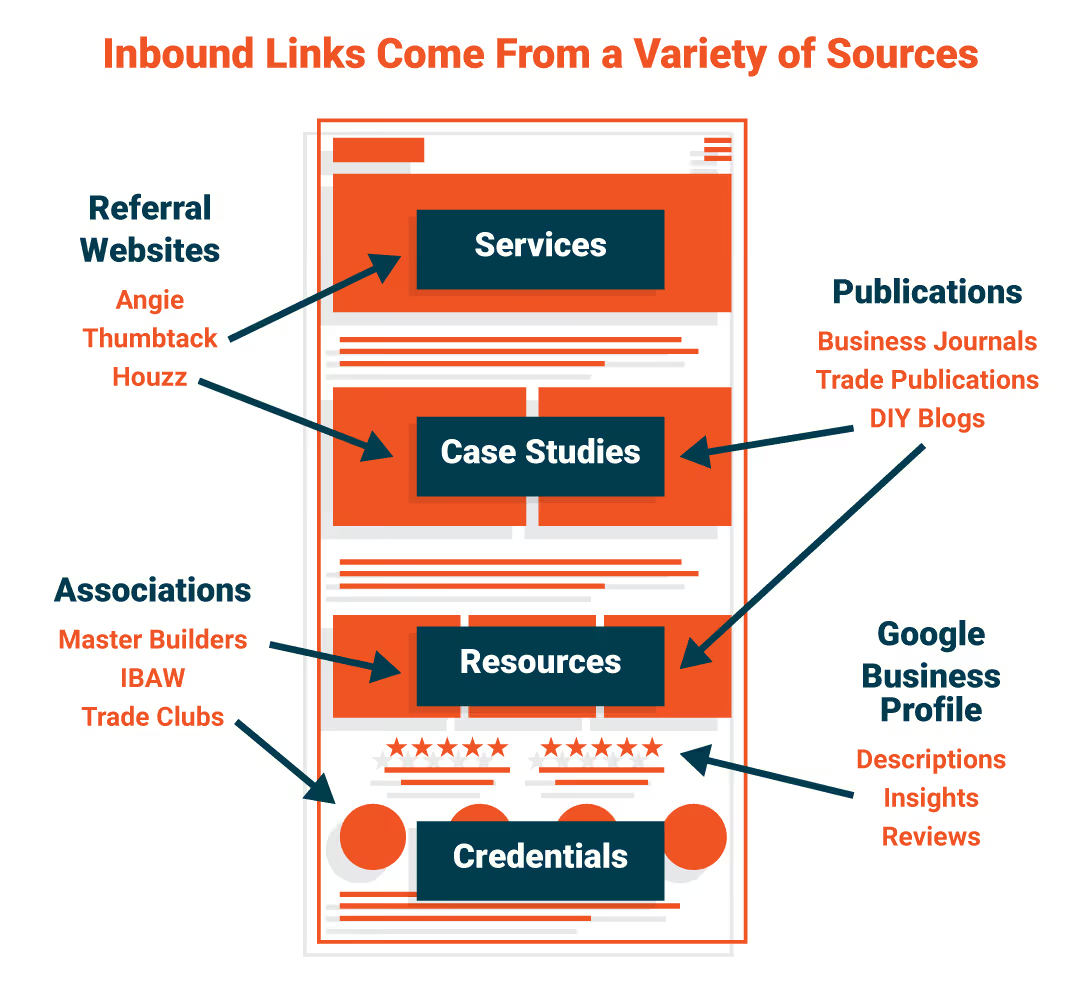
You may be souring on sites like Angie, Thumbtack and Houzz because it seems they only provide bottom feeding leads. But they serve another purpose. These sites have millions of visitors every year, which gives each of them high domain authority. When you post your profile with your website address, it gets counted as a quality inbound link.
A consistent presence across multiple credible directories sends positive signals to search engines. And for local search specifically, being listed on multiple platforms that mention your business name, address and phone number consistently helps Google verify that you are a legitimate, established business in your area.
Trade and builder associations are generally more valuable. When the Associated General Contractors, a regional construction association, or a manufacturer's certified installer program links to your website, that is a credible, industry-relevant inbound link that Google values highly. You should make it a priority to get listed in every relevant association directory you qualify for.
Are Backlinks Still Necessary in the Age of AI Search?
As AI-powered search tools like Google's AI Overview, ChatGPT and Perplexity become more common, the sources those tools pull from to generate answers are heavily influenced by domain authority. If your website has a strong backlink profile, AI tools will trust it enough to cite and use as a reference when your prospects ask them for recommendations.
How AI Can Help You Build Your Inbound Link Strategy
AI tools can help you identify linking opportunities you would never find on your own. There are limitless possibilities to gather inbound links, and AI tools make a great partner to enhance your chances.
Ask an AI tool to find every industry association, trade publication, manufacturer partner directory, regional business journal and certification body in your space that publishes member or partner listings. You will get a list that would take a human researcher days to compile in about thirty seconds.
AI can also help you draft outreach emails to editors, journalists and association administrators when you are trying to earn a mention or a listing. It can help you identify which of your competitors have strong backlink profiles so you can target the same sources they are using.
AI can do the research and help you generate ideas for content that is genuinely worth linking to, like technical guides, project case studies, industry data and how-to resources.
The Easiest Steps to Start Building Backlinks
Building backlinks is a deep rabbit hole and there are entire careers and college courses built around mastering it. But here are a few practical suggestions to get the ball rolling.
Claim and complete your Google Business Profile if you have not already. This is free and it is the single most impactful local SEO action you can take. Make sure your name, address, phone number and especially your website are accurate. Google’s domain authority is 99 if you didn’t know.
Get listed in every relevant trade association directory you qualify for. AGC, your regional builder association, any manufacturer certification programs you participate in. Call them if you have to. Make sure they have your current website address.
Make a goal to add several case studies to your website’s project or portfolio section. Describe your most notable projects, and include the challenges you were faced with, the solutions you came up with and the results. These are the kinds of pages that journalists, industry publications and partner companies link to when they are referencing real-world examples of work in the industry.
Reach out to your material suppliers and ask if they have a contractor or dealer locator on their website. Most do. Make sure you are listed on every one of them with a link back to your site.
Submit your company to regional business journals and industry publications. Many of them publish annual lists of top contractors, fastest growing companies and notable projects. Getting on those lists generates high quality editorial inbound links that carry real weight.
Finally, set a reminder to check your backlink profile every quarter using one of the free tools mentioned above. Watch the number grow over time and use the data to identify new opportunities as they emerge.
Dead links are Deadly!
If you recently updated or relaunched your website, make absolutely sure your developer set up 301 redirects on all your new pages. This is one of those things that is easy to overlook and really painful to ignore. A 301 redirect takes any inbound link pointing to your old pages and automatically routes it to the right new page. Without them you end up with dead links, and dead links are a red flag to search engines that will drag your domain authority and your rankings down fast.
Inbound linking is not glamorous work. But it is the kind of steady, compounding effort that separates the companies landing on page one of search engines or abandoned in the purgatory of page 2 and beyond.
Your competitors are not thinking about this. Which is exactly why you should be.

Written by Rusty George, with almost zero help from Artificial Intelligence. AI contributed approximately one decent sentence. You'll never know which one.
Rusty George leads a branding, website design and marketing agency serving construction companies, developers, subcontractors, manufacturers, material fabricators and suppliers. Reach out anytime to talk about how backlinks can boost your website to bring in more leads.
MORE Insights
Unlock the secrets to transforming your construction company into a marketing powerhouse with Louder Builder.
Your Online Visibility Machine
The Google Business Profile
SIGN UP FOR UPDATES
We will send you our latest insights from Louder Builder as they are released.
CONTACT US
Are you ready to begin your project today? Just have a few questions?
Either way, let’s talk.