
Content Marketing: The Best Biz-Dev Tool You're Already Qualified For
Content marketing helps you earn trust by being helpful before you ever ask for the business. It matters more now than ever. Make your prospect the hero of every story you tell, follow the simple GUIDE framework, and let your expertise do the selling for you.

"Your customer is not a moron. She’s your wife."
That quote is by David Ogilvy, the father of modern advertising and one of the great marketing minds of the twentieth century. He built some of the most iconic brands in history not only with clever ads and slogans, but by writing with authority, specificity, and genuine respect for his reader.
He understood something 75 years ago that is more relevant than ever today: people don't want to be sold to. They want to be helped.
You might have heard the term "content marketing" floating around and haven't given it much thought. It's just another vague buzzphrase to you, not having anything to do with how you as a builder actually attracts and wins work.
But you've felt the ground shifting lately. Competition is only getting more brutal every day. Digital advertising costs are going up and the response rates are dropping. Inquiries from your website contact form have slowed to a trickle, sometimes making you wonder if it's still connected.
The problem is, you've been grinding away on the transactional tactics that used to work well, but buyers aren't looking for building partners like they used to. There's something new going on now.
Your Audiences are Evolving
The way your prospects actually find and evaluate vendors has changed completely in the last five years or so. They're still out there but they're a lot less cavalier and more cautious in selecting their contractors. Sure they appreciate deals, but that's not what drives them on a gut level.
They want the trust and confidence that the project they're considering investing in will be successful and not a disaster. They’re skeptical, anxious and apprehensive about making the wrong move.
There's no doubt they're online researching way before they even think about calling anyone. They're reading articles, watching videos, and looking for experts who actually know what they're talking about.
They're asking AI tools for recommendations, and those tools are pulling from the same online sources. They're checking LinkedIn to see who's contributing real insights that come from experience learned in that niche area.
What is Content Marketing?
Joe Pulizzi, the inventor of the concept, explains: "Content marketing is a marketing technique of creating and distributing relevant and valuable content to attract, acquire, and engage a clearly defined and understood target audience, with the objective of driving profitable customer action."
For builders, content marketing is drawing upon your hard-earned expertise and sharing genuinely useful information that your ideal future customers actually want to learn from.
It's about dialing back the gimmicks and sales speak and developing a library full of answers to the exact question your prospect has been Googling at midnight.
It's the video that walks a facilities manager through what to look for when evaluating a mechanical contractor. It's the case study that shows a developer exactly how you solved a problem on a project just like theirs. It's the insight that makes a project manager look smart in front of their boss.
This is not a quick-result approach, but a long-term play that builds up over time. When you do this consistently, your ideal future customers begin to recognize your name. Then they begin to trust you. And then, when they finally have a need, your name is the first one that comes to mind.
The name of the game in business development is being seen by the search engines that steer customers looking for someone who does what you do toward your website before your competitors'. Their business models revolve around providing the best answers to the questions their users are asking, and if you have them on your website, they are far more likely to introduce you over those who don't.
They aren't prioritizing sites with the most keywords anymore. They've learned from and moved beyond that. As a matter of fact, they've started penalizing sites that still do that.
But none of that content, the articles, the videos, the case studies, means anything if it isn't actually saying something. Getting found is only half the job. What you say once someone's reading is the other half, and that's where most builders lose the room.
Every Piece of Content Is a Story
Humans have always instinctively responded to stories. We've been sharing and listening to them since the dawn of time. And whether you realize it or not, every piece of content you publish, every article, every case study, every video, is a story. The only question is whether you're telling it well.
Most builders get their story backwards. They write content about themselves: what they built, how many years they've been in business, the awards on the wall. That's not a story. That's a resume with better formatting, and nobody bookmarks a resume.
A real story works differently. Think about how any good one is built: the hero has a problem, they're lost or stuck, and they need someone who's been there before to show them the way through to a successful outcome.
Your prospect is the hero of every piece of content you create, whether it's a case study, an article, or a two-minute video. You're not the star here. You're the guide, the character who's walked this exact road a hundred times and knows precisely how to get someone else home safely.
Your expertise, history, and team all matter, but only in service of that role. Your credentials prove you can actually be the guide for our hero, but it's not the point of the content you are writing. It just earns you the right to tell it.
So before you publish anything, ask yourself: does this put my prospect at the center of their own problem, or does it put me at the center of my own accomplishments? Here's the problem you're facing, here's why it's harder than it looks, here's how we've helped someone exactly like you get through it. That's the shape of every piece of content that actually works. You are not writing your biography. It's a story your reader can see themselves inside of, told in a way a stranger would actually want to read to the end.
That's the foundation. Everything from here forward is just that same story, told one piece at a time. Here's how to make sure each piece hits.
The GUIDE Framework for Content That Actually Works
The hardest part of content marketing for most builders isn't the writing. It's knowing what to write about and how to approach it. Here's a simple framework to keep you on track.
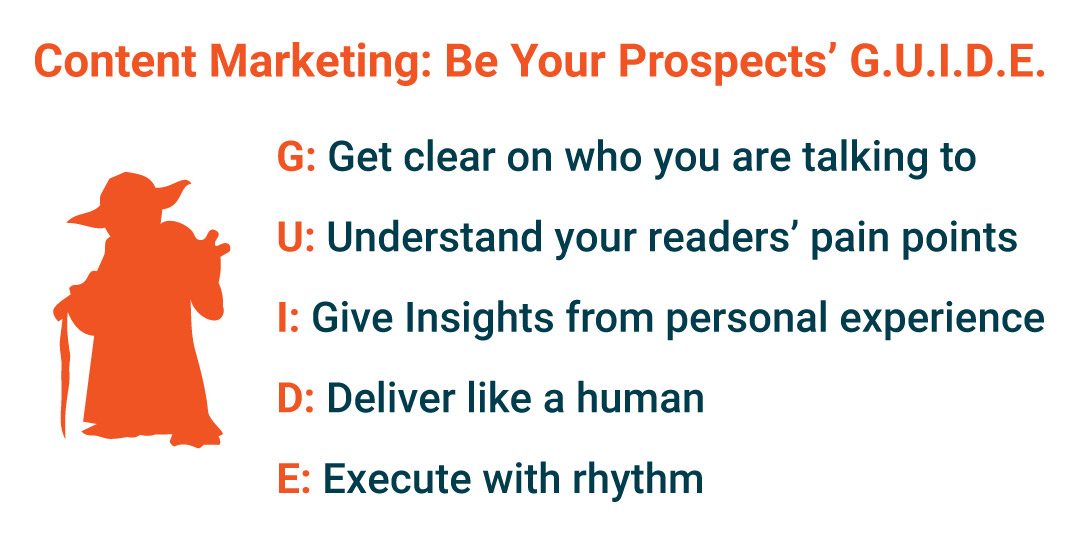
Think of it as being your prospect's GUIDE.
G: Get clear on your audience.
Before you write a single word, you have to know exactly who you're writing for. Think of your ideal future customer and make them real in your mind. What do they like to do when not making decisions on a large building project? What kind of car or truck do they drive? What do they do for entertainment? What media channels do they prefer? Get crystal clear so your writing isn't vague but really connects with them.
U: Uncover their pain points and desires.
What keeps your ideal reader up at night? What would make their career easier, safer, or more successful? What question are they desperate to have answered by someone who actually knows what they're talking about? Your content should speak directly to those things, the most important topics they will find interesting.
I: Insights from your niche expertise.
This is where your advantage lives. You know things your audience doesn't. You've seen problems they haven't encountered yet. You've developed solutions they'd pay good money to learn about. Your job is to take that expertise and translate it into content that's genuinely useful to someone outside your world.
The more specific and niche your subject matter, the better. A plumbing contractor who writes about the three most common mistakes developers make when spec-ing pipe for high rise residential is going to get more traction than one who writes about plumbing in general.
D: Deliver it like a human.
Write the way you talk. Don't get over-formal or default to industry jargon that only you understand. Write the way you'd explain something to a smart colleague over lunch. If it sounds like a press release, start over. It's not about impressing but sharing real knowledge they'll understand.
E: Execute with a rhythm.
Content marketing can't be thought of as a one-and-done campaign. You have to commit to it enough that it becomes a ritual. Get into a rhythm of providing something genuinely useful over and over, consistently, without expecting immediate results.
A cadence I prefer is the give-give-ask method. Provide two pieces of helpful content, whether it be an article, white paper, case study or video, etc., and then one call to action. And don't default to pleading for business, ask if the content you're providing is helpful and if your prospects have any suggestions on other topics. This is a disarming way to get a productive conversation rolling from one colleague to the next.
A structural engineer I know spent eight months publishing short breakdowns of code violations he kept seeing on inspections, nothing polished, just "here's the mistake, here's the fix." A developer found one of those posts while vetting contractors for a mixed-use project, called him directly, and skipped the RFP process entirely. That's the whole system working exactly as designed.
The Patience Problem
You can never expect content marketing to deliver an immediate return on investment. You can publish ten articles and hear nothing but silence. You can post insights on LinkedIn for three months with minimal engagement. You can send a newsletter to a list of fifty prospects and get zero responses.
But you have to keep going anyway.
Business development is about long term relationship building, not transactional quick wins. You build a collection of valuable information, one brick at a time. Every piece of content you create is a deposit into a credibility account. The returns are real, but they're compounding slowly and invisibly.
Your prospects are reading your content even when they don't respond. They're sharing it with colleagues. They're filing it away mentally under "this person knows what they're talking about." And when the moment comes, when they have a project, a budget, and a need, your name is already in their mind as the trusted expert.
The Content Credibility Ladder
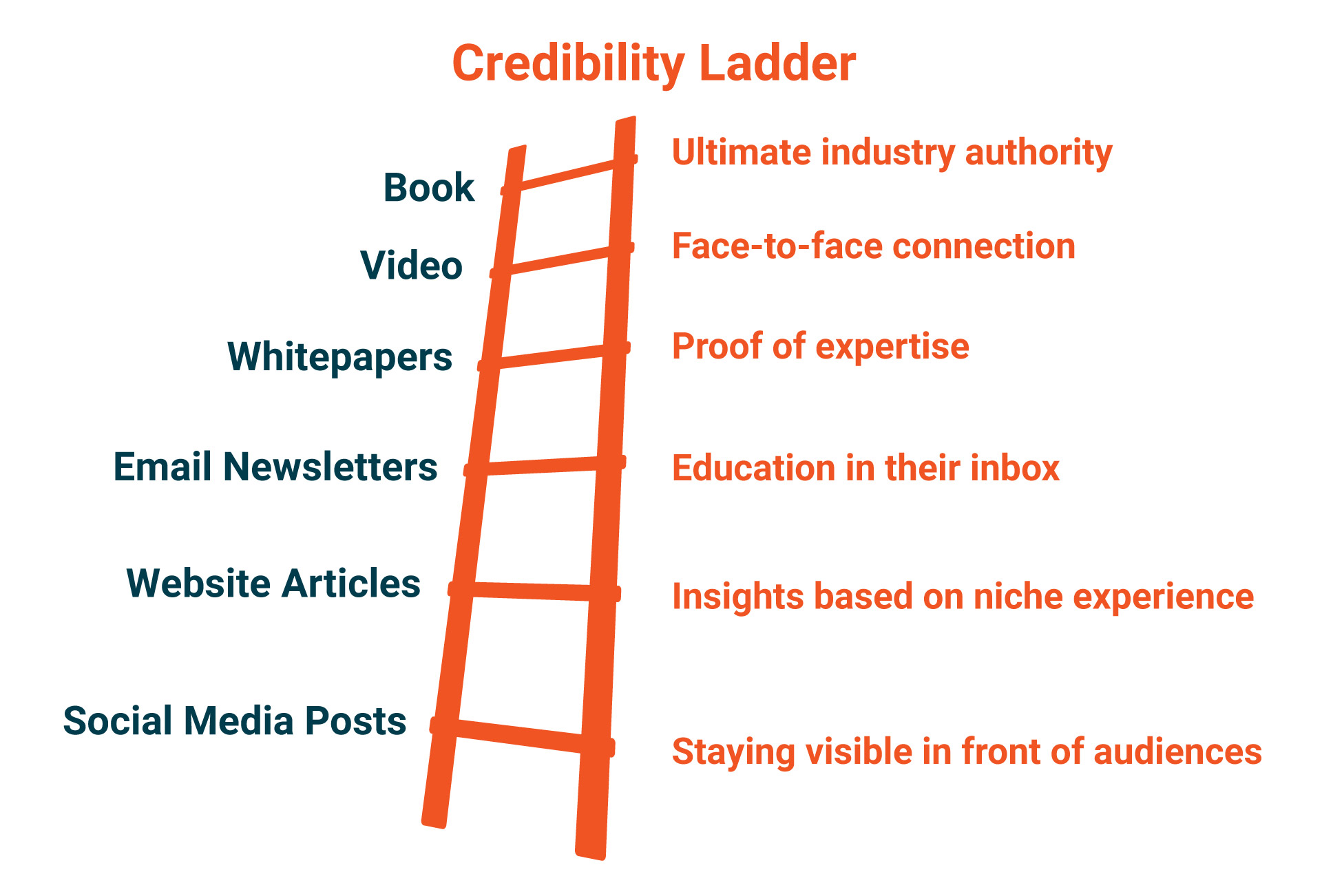
Not all content carries the same weight. Think of your content marketing efforts as a ladder of credibility, with each rung building on the one before it.
At the bottom rung of the ladder are social media posts. Quick, accessible, easy to share, and good for staying visible in front of your audience on a daily basis.
One rung up are articles on your website. Longer, more substantive, and far more valuable for search engine visibility and AI citation. Every article you publish is a door that a future client can walk through to find you.
But stay away from leaning too heavily on ChatGPT or Claude to write them for you (readers and algorithms both notice the tell). This can actually hurt your credibility score for both search engines and discerning humans.
Above that are email newsletters, which land directly in the inbox of people who have already expressed interest in what you have to say. This is your warmest audience and deserves your best content.
Higher still are case studies, white papers, and in-depth guides. These take more effort to produce but carry enormous weight with the kinds of sophisticated buyers who make large purchasing decisions. A well-crafted case study that walks a prospect through a complex problem you solved is worth a hundred generic social posts.
One rung above that is video. It does something none of the written rungs can: it puts a face and a voice behind the expertise, and gives a busy prospect something they can absorb without having to sit down and read. A ten-minute walkthrough of how you solved a tricky foundation problem does more to build trust than the same information in an article, because your prospect can see you actually know what you're talking about.
Video is also becoming AI's preferred source for gathering and synthesizing information. A solid library of knowledgeable video content increases your odds of being cited and recommended by the same AI tools your prospects are now asking for referrals.
And at the very top of the ladder is a book.
Writing a book puts you in a category that almost none of your competitors will ever reach. It's the ultimate demonstration of expertise, the ultimate credibility builder, and the ultimate conversation starter.
This could be a digital e-book like a quick-start field guide or a comprehensive manual on your products or services. It's a definitive guide on your area of specialty, and if sent to a prospect the entire dynamic of that conversation changes. You're no longer a vendor. You're an authority. And authorities don't compete on price.
Content as the Foundation for Everything Else
Here's what makes content marketing so powerful as part of a broader business development strategy. It doesn't just build awareness on its own. It makes every other tactic you use work better.
When you send a cold email or a direct mail piece to a prospect, the quality of that outreach goes up dramatically when it's backed by real content and real expertise. Instead of a generic pitch, you can reference a specific challenge you know they're facing, share an insight from your own experience that's directly relevant to their situation, and point them to an article or resource that proves you actually know what you're talking about.
That kind of outreach puts you in a different category than ignorable spam. It feels like a gift: something you went out of your way to send them.
Think of your content as the proof behind your promises. Anyone can claim to be an expert. The builder who has spent six months writing about their area of specialty, sharing insights, answering questions, and demonstrating their knowledge in public doesn't have to claim anything. The evidence speaks for itself.
David Ogilvy also said: "The more informative your advertising, the more persuasive it will be."
Be your ideal future customers' Ogilvy. Be the person who wins them over, slowly and consistently with something worth reading, worth sharing, and worth trusting.

Written by Rusty George, with almost zero help from Artificial Intelligence. It was built the old-fashioned way. Splinters and all.
Rusty George leads a branding, website design and marketing agency serving construction companies, developers, subcontractors, manufacturers, material fabricators and suppliers. Reach out anytime to swap war stories and discuss how to use them to build a content marketing strategy.
MORE Insights
Unlock the secrets to transforming your construction company into a marketing powerhouse with Louder Builder.
Your Online Visibility Machine
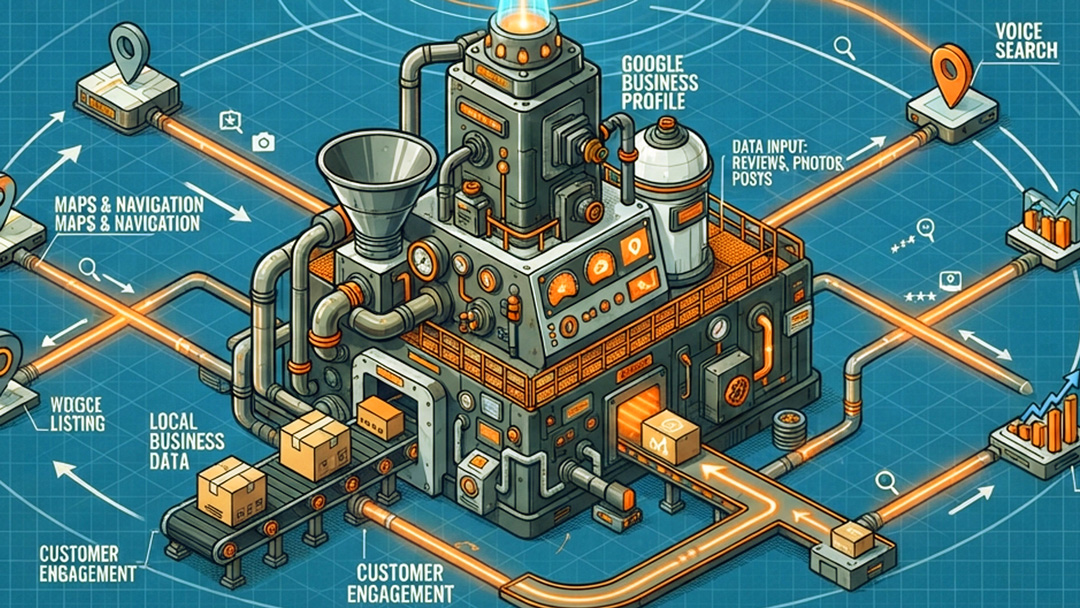
The Google Business Profile
SIGN UP FOR UPDATES
We will send you our latest insights from Louder Builder as they are released.
CONTACT US
Are you ready to begin your project today? Just have a few questions?
Either way, let’s talk.